
I’m Andy, founder of The Hoops Geek. As a developer and lifelong hoops geek, I am building the best possible tools for basketball coaches.
thehoopsgeek.comHedge defense pushes emphasizes immediate pressure on the ball handler to force quick passes or turnovers.
In a low drop, the screener’s defender is positioned near the nail, sometimes even deeper into the paint.
High Drop defense raises the screener's defender to make it easier to contain the ball handler compare to a low drop defense.
Ice defense, also known by many names like Blue, Down, or Push, aims to force the ball handler towards the sideline. Most teams use screens to attack the middle of the paint, creating multiple options, but Ice defense disrupts this by steering the screen action to the side.
The box and 1 is a hybrid defense that combines man-to-man principles with zone concepts to create defensive chaos and neutralize a dominant scorer.
Hedge defense has long been a cornerstone of screen coverage, especially against offenses that lack strong floor spacing and shooting. By applying immediate pressure on the ball handler, Hedge forces them to either give up the ball early or struggle to initiate the offense effectively, disrupting the flow of the opposing team’s attack.
The goal of Weak defense is straightforward: to force the ball handler toward their weaker hand. Since the majority of players are right-handed, Weak defense typically means "forcing them left." To avoid confusion, many coaches simplify this by defining Weak as "left" and Strong as "right". Weak Defense is almost always paired with Ice coverage being used for side screen actions.
Ice defense, also referred to as blue, down, or push, is designed to force the ball handler toward the sideline. Many teams prefer to set screens that allow the ball handler to attack the middle of the court, where more scoring opportunities typically arise. Ice defense counters this philosophy by having the on-ball defender jump toward the screen, leaving the ball handler with no choice but to reject it and drive toward the sideline.
As teams began countering the Low Drop with a High Screen, a new defensive strategy emerged—the High Drop. This coverage addresses the spacing weaknesses of the Low Drop while continuing to protect the highest-percentage shot in basketball, the layup, through the "no man behind" defensive philosophy. Additionally, it still encourages the most inefficient shot in basketball: the long two-pointer. However, like any defensive scheme, the High Drop is not without its vulnerabilities. There are effective ways to exploit this coverage and turn it into an advantage for the offense.
In a Low Drop coverage, the screener’s defender drops deep into the middle of the paint to prioritize protecting the rim and contesting the highest-percentage shot in basketball—the layup—while deliberately allowing the least efficient shot: the long two-pointer. This strategy also offers additional benefits. It adheres to the defensive philosophy of "no man behind," enabling two defenders to handle the pick-and-roll without needing help from a tag man or a low man, thus keeping the rest of the defense intact.
Many coaches teach players to set screens at a 45-degree angle, with their back facing the corner of the court. While this advice is generally effective for on-ball screens, it often fails to explain why the 45-degree angle works so well.
This is a continuous offense that is particularly effective against a 2-3 zone. It is depicted here with the defensive shifts and all of the potential options. This offense works best when your players are equipped with basketball skills, such as the "read and react" knowledge.
This play is best used against 2-3 zone but will work against man-to-man if players make good cuts.
This is a quick hitter play that is great for the end of a quarter. It works best against a zone, but also works against man-to-man.
This is a continuous offense that can be used as a quick hitter. This works against any half court zone.
Outlet pass & transition after a defensive rebound
This play starts with the ball handler drawing their defender into an initial ball screen, then quickly pivoting to receive a second screen from the opposite side. It’s tough to defend because the defense must navigate two screens in rapid succession.
The Horns "Flex" play elevates the standard Horns set by introducing more dynamic and engaging actions. This variation of Horns, gets the wings involved and uses the zoom motion to create scoring chances.
The foundational concept of the horns offense emphasizes floor spacing, creating an ideal setup for a traditional pick-and-roll action with a backdoor cutting option toward the basket. Corner wings play a critical role by maintaining proper spacing to stretch the defense. If the wing defenders collapse to help, the wings must be prepared to capitalize on a kick-out for a high-percentage three-point opportunity.
The high post is a vulnerable position in the 1-3-1 zone defense and we try to force the ball out of there as quickly as we can.
In the tight 1-3-1 Zone Defense, all the same rules apply except the defense is not trapping AND the players are more tightly packed in during the entire defensive possession. The main goal is to prevent the ball from entering the zone, and if it does, to quickly collapse on it and force it back outside.
As the dribbler crosses the half-court line, the ball-side wing will step up and set a trap. We try to force the offense to pick up the dribble and throw a weak lob pass that we can pick off.
As the name suggest, the 1-3-1 zone defense is set up in a 1-3-1 formation. It can be used in a multitude of ways - as a base defense, a change-of-pace defense, a trapping defense, and more.
If we want to put extra pressure on the offense we can play a 1-3-1 Zone Defense where we start picking up the ball at the opposing free throw line.
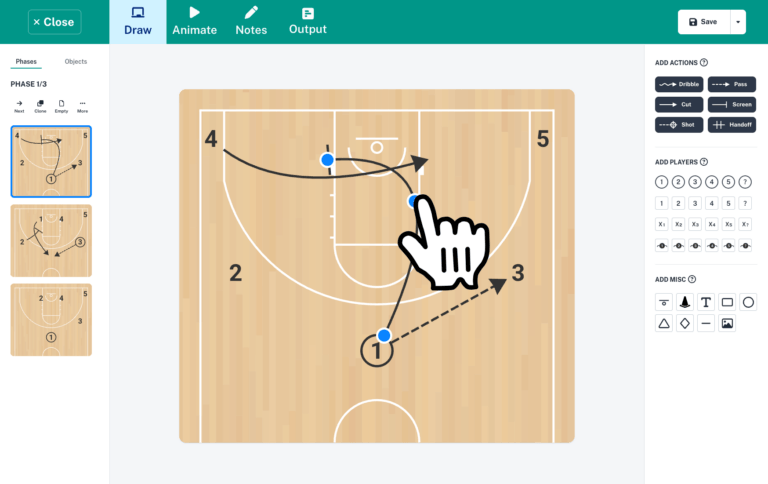
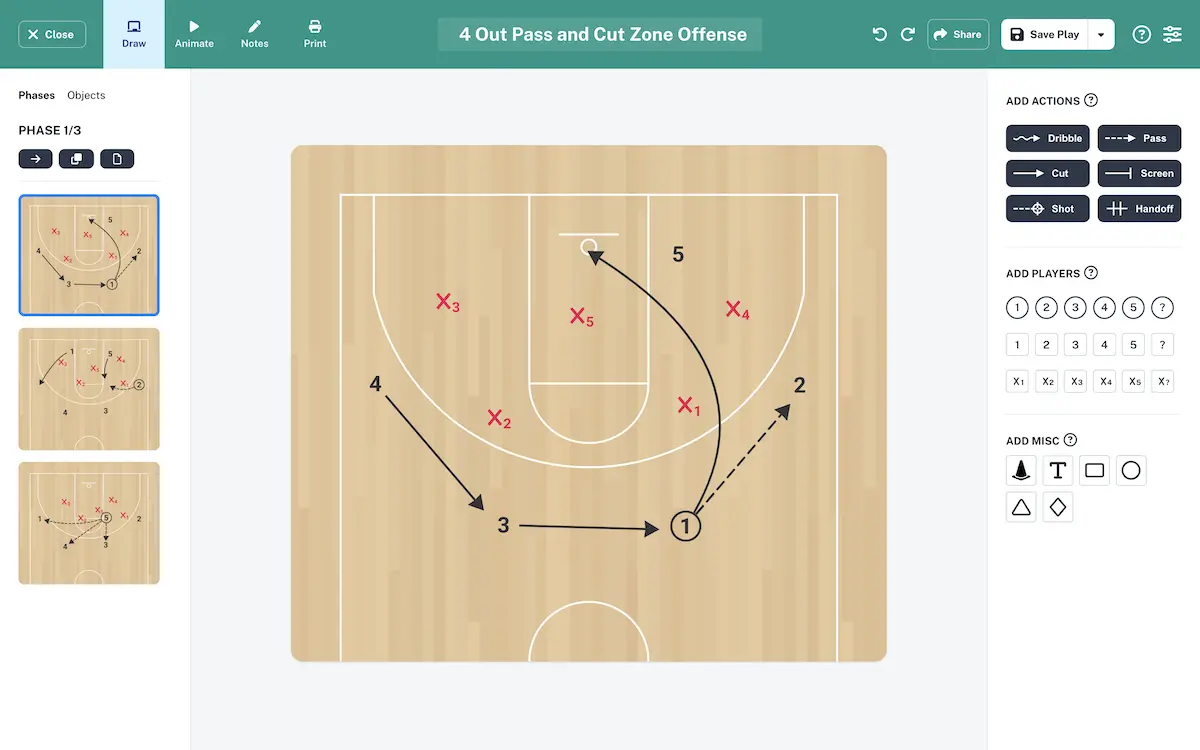
Create plays with our intuitive drag & drop editor.
Your plays will be animated automatically!
© 2026. The Hoops Geek


