Basketball is a game of creating numerical advantages by forcing a double team. This can be achieved through elite isolation play, post-up mismatches, dribble penetration, or screen action. Zoom action blends screen action and dribble penetration to generate these advantages. By combining a down screen with a dribble handoff (DHO), it creates space and enables players to attack the paint with speed, forcing defensive breakdowns and leading to high-quality scoring opportunities.
What is Zoom Action?
Zoom action is a dynamic offensive sequence built around three key components:
1. Down Screen
A screener sets a down screen for the primary decision-maker, who uses it to gain separation from their defender and move toward the ball. This initial screen allows them to receive the ball in motion, already creating an advantage.
2. Dribble Handoff (DHO)
The ball handler, typically a big man, dribbles toward the receiver and executes a dribble handoff (DHO). A DHO functions as both a pass and a screen, enabling the receiver to attack immediately without slowing down. This action forces the defense to react instantly—deciding whether to switch, fight over, or go under the handoff.
3. Decision Making
Once the primary decision-maker receives the ball, they must quickly read the defense and respond:
- Drive to the basket if the defender is trailing.
- Pull up for a shot if the defender goes under.
- If the defender stays attached, the big can re-screen to shift the defense and create a new angle of attack.
- Make a quick pass to exploit defensive rotations and find an open teammate.
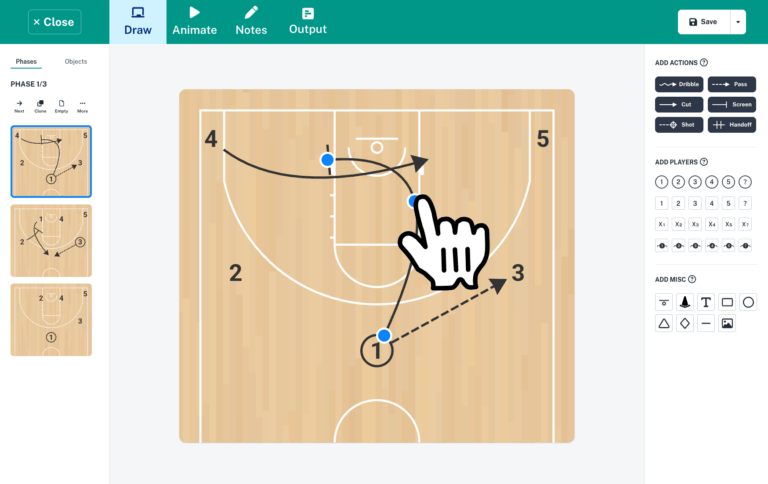
After the Zoom Action, if the defender is trailing, 1 can attack the rim, taking advantage of the outnumbered situation. The options are:
- Finish at the rim if there's a clear path.
- Pass to the rolling 5, who may have an open look inside.
- Kick out to 3, who has lifted toward the wing, pulling his defender away from baseline help.
- Kick out to the opposite corner for an open three.
After the Zoom Action, if the defender is trailing far behind or goes under the screen, 1 should pull up for a shot to take advantage of the open space.
After the Zoom Action, if the defender stays attached, 5 can re-screen for 1, creating a better angle for an attack.
The Zoom Action can create defensive confusion, causing two or more defenders to converge in the same spot. If 1 gets double-teamed, they can quickly pass to 5 in the short roll zone, allowing 5 to make a play.
If 3’s defender sags off to help on 5, leaving 3 wide open, 1 can make a quick pass to 3, reading the defense.
For optimal spacing, it's crucial to have both pop and roll options, regardless of the players involved. If both 3 and 5 roll or pop simultaneously, it makes it easier for defenders to cover the area, reducing the offensive advantage.
Why Zoom Action is a Nightmare for Defenses
Three-man actions like Spain Pick-and-Roll, Double Drag, and Horns Offense are notoriously difficult to guard because they demand perfect defensive synchronization from at least three defenders—unlike traditional pick-and-rolls, which typically require coordination between just two defenders.
Similarly, Zoom action creates chaos for defenses by involving multiple moving parts, including screens, handoffs, and potential kick-outs. To neutralize Zoom action, defenders must not only communicate and rotate perfectly but also anticipate multiple scoring options, which can be overwhelming.
The unpredictability of Zoom action makes it a defensive nightmare, as offenses can seamlessly transition into secondary actions like ball screens, backdoor cuts, or weak-side movement, keeping the defense in a constant state of reaction.
Roles in Zoom Action
Bigman
The bigman initiates the Zoom action and plays a crucial role in setting up scoring opportunities.
Responsibilities:
- Dribble toward the receiver while controlling tempo and setting up the DHO at the right angle.
- Read the defense—attack if defenders sag off or make the pass if a teammate gets open.
- Be ready to re-screen or slip into a secondary action if needed.
- If the defender overplays, pass to the screener or receiver on the backdoor cut.
Receiver
The receiver is the primary decision-maker in Zoom action, as they get the ball on the move and must quickly determine the best scoring option.
Responsibilities:
- Use the down screen effectively to create separation before the handoff.
- Maintain speed through the DHO to keep the defense off balance and maximize attacking options.
- Read the defense and choose to drive, shoot, pass, or call for a re-screen based on the defender's positioning.
- If the defender overplays the initial screen or DHO, cut straight to the basket.
Screener
The screener plays a pivotal role in freeing up the receiver and potentially becoming a scoring option if the defense collapses.
Responsibilities:
- Set a well-timed down screen to maximize separation for the receiver.
- Roll, pop, or slip based on defensive coverage and spacing needs.
- Recognize weak-side rotations and relocate for potential passing opportunities.
Variations of Zoom Action
While Zoom Action can be executed in various ways, the most widely recognized “standard” setup involves the action starting from the corner and flowing up to the top of the key for a dribble handoff (DHO).
Wing Zoom Action
While the corner-to-top Zoom Action is widely recognized as the standard setup, another common variation involves running Zoom Action from one wing to the other while keeping players spaced in the corners.
Watch Murray (#27 in white) as he moves—he casually walks to his spot, then bursts into a sprint around Gordon (#32 in white), ensuring Dort (#5 in black) gets caught on the screen.
After the handoff, Murray had the option to turn the corner and attack downhill, but he recognized that Dort was trailing far behind—a result of the two screens from the Zoom Action. Instead, Murray steps into a three, exploiting the space Hartenstein (#55 in black) gives by playing drop coverage.
With Dort already out of position, he’s forced to leave his feet to contest the shot, and Murray smartly uses a pump fake, sending him flying past. Although the shot didn’t fall, the Zoom Action created the space and time Murray needed for a high-quality look.
- Pass the ball to the big man
- 1 cuts below the 3-point line to prepare receiving a down screen
- 4 sets the down screen
- 5 dribbles with the ball towards the screened player and hands the ball off
If 1’s shot is cut off, they have several options:
- Drive and finish at the rim if there’s still space.
- Find the rolling 4 for an inside scoring opportunity.
- Pass to 5 for a three if the defense collapses inside.
SLOB Zoom Action
The advantage of running Zoom Action at the elbow is the multiple offensive options if the primary action breaks down. Take a look at this Sideline Out of Bounds (SLOB) play as an example.
The play was designed for Murray (#27 in white) to attack downhill off a handoff from Jokic (#15 in white), but Dort (#5 in black) plays excellent deny defense, preventing Murray from getting the ball. The secondary action for Porter Jr. (#1 in white) also breaks down as Dort disrupts the pass.
With both options covered, Jokic puts the ball on the floor and takes his defender to the rim. Starting from the elbow gave him a natural advantage, allowing him to get closer to the basket. In just seconds, Zoom Action created three strong offensive options, showcasing its versatility and ability to keep defenses off balance.
- 4 sets a down screen for 1
- As 1 comes up to the top of the key for a handoff
- Simultaenously, 3 passes the ball to 5
- 1 can attack downhill off of a handoff or run a 2-man game with 5
- If the pass to 1 is denied, 3 can curl around and receive a handoff
- If the handoff option is not available, 5 can attack the basket.
Empty Zoom Action Variation
Zoom Action is so widely used that defenses often anticipate a specific path once they recognize the setup. Coaches can leverage this expectation by incorporating decoy movements, creating different scoring opportunities while maintaining the same structure.
This setup appears designed for Bol (#11 in black), but he acts as a decoy for Booker (#1 in black). As Bol cuts backdoor, it triggers Booker to receive the DHO from Richards (#2 in black).
Because Booker is a major perimeter threat, both defenders in white focus on him, leaving Richards with a clear roll lane. This action forces a 4v3 advantage on the backline, creating an easy scoring opportunity through a simple yet deliberate movement.
- 1 sets a screen for 4 and initiate the Zoom Action
- 4 fakes the Zoom Action and cuts to the opposite corner
- Simultaenously, 1 receives a handoff from 5
Corner Zoom Action Variation
Zoom Action has become so popular that coaches often disguise it to keep the defense from anticipating the play.
After Harris (#13 in blue) passes to Duren (#0 in blue), instead of setting a screen for Cunningham (#2 in blue) in the corner for Zoom Action, he cuts into the paint. This movement triggers Hardaway Jr. (#8 in blue) to move toward the ball, appearing to set up a handoff for a downhill attack. However, instead of receiving the handoff, Hardaway Jr. sets a screen for Cunningham (#2 in blue), becoming the screener for Zoom Action.
This play highlights how coaches disguise actions, using misdirection to throw curveballs at the defense and keep them off balance.
- 4 fakes a down screen and cuts to the other side
- 3 fakes a handoff and screens for 1
- 1 comes up to the top of the key and execute a handoff with 5
Horns Zoom Action
There are multiple ways to initiate Zoom Action. Here, the Boston Celtics use the popular Horns setup to trigger the action.
As Horford (#42 in black) catches the ball, Smart (#36 in black) runs to set a down screen for Tatum (#0 in black), initiating Zoom Action. With Horford beating his initial defender off the dribble, Porter Jr. (#32 in white) is forced to drop to help. Meanwhile, Smart’s screen on Wiggins (#22 in white) creates enough separation for Tatum to get an open three.
Notice how the Celtics initially disguised the Zoom Action within the Horns setup. Also, the Horns setup naturally allows the Zoom Action to flow in either direction. If Smart had caught the ball, the play would have instead triggered a Zoom Action for Brown (#7 in black) on the opposite side.
- 1 passes the ball to 5 and cuts to the strongside
- 3 lifts to provide spacing
- 2 sets a down screen for 4 in the corner
- 5 simultaenously looks for a dribble handoff (DHO) with 4
- 4 uses the screen and executes a DHO with 5
Zoom Action Motion Offense - Washington Wizards
As shown in the previous example, integrating Zoom Action into a team's motion offense is a common strategy. Take a look at the Wizards' Zoom Motion Series to see how they seamlessly incorporate it into their offensive flow.
After passing to Holmes (#22 in white), Smart (#36 in white) sets a down screen for Kispert (#24 in white). However, instead of cutting to the wing for the handoff, Kispert curls toward the basket, forcing the defense to react. This movement triggers Smart to come up for the handoff, creating a 2-on-1 advantage for the offense.
- 5 flashes to the elbow and receives a pass from 1
- 1 then sets a down screen for 3
- 3 fakes a handoff and cuts to the other side of the court
- 2 lifts to provide spacing
- 1 executes the handoff with 5
This time, Champagnie (#9 in white) initiates the action. After passing to Holmes (#22 in white), he sets a down screen for Kispert (#24 in white), who once again curls toward the basket. However, notice how Champagnie’s defender locks onto him, preventing movement. Seeing this, Holmes looks to the opposite side to keep the offense flowing. Carrington (#8 in white) cuts to the basket, and Smart (#36 in white) receives the handoff to finish the play.
- 5 flashes to the elbow and receives a pass from 1
- 1 then sets a down screen for 3
- 3 fakes a handoff and cuts to the other side of the court
- 2 lifts to provide spacing
- If 1 is being heavily guarded and can't receive a handoff from 5, 5 looks to the other side of the court
- 4 then fakes the handoff and cuts to the other side of the court
- 1 lifts to provide spacing
- 5 dribbles to the top of the key and executes a handoff with 2
Just like this, Zoom Action isn’t just a standalone play—it can seamlessly integrate into a team’s motion offense, making it even more effective when executed properly. Dan Hurley’s UConn team is a great example, known for its intricate offensive sets that incorporate Zoom Actions.
Check out this detailed breakdown to see how they use it to create advantages.

Zoom Action Drills for Players
Read & React: 3-Level Scoring Drill
Why This Drill is Important
A receiver’s 3-level scoring ability is crucial in Zoom Action. To maximize spacing and offensive options, the receiver must be a threat to score from three, mid-range, and at the rim immediately after the catch. This drill helps develop shooting consistency, decision-making, and scoring versatility off the handoff.
1 starts in the corner, curls up to the top of the key, and receives the handoff from 5.
1 shoots right after the handoff
1 takes one dribble towards the rim and pulls up for a shot
1 takes it all the way to the rim
1. No Defenders
- Corner to Three: The receiver starts in the corner, curls up to the top of the key, receives the handoff, and shoots a three.
- Corner to Mid-Range: The receiver starts in the corner, curls up to the top of the key, takes one dribble inside the perimeter, and pulls up for a mid-range shot.
- Corner to Rim Attack: The receiver starts in the corner, curls up to the top of the key, makes a quick move, and finishes at the rim.
- Repeat on the opposite side to develop balance and versatility.
2. Dummy Defenders
To make this drill more realistic and effective, introduce a dummy defender on both the receiver and the big man executing the handoff. This forces the receiver to read the defense and react accordingly:
- If the receiver’s defender sags on the handoff → Shoot a three.
- If the defender chases over the top & the big man’s defender plays low drop → Take one dribble inside the perimeter and pull up for a mid-range shot.
- If the defender chases over the top & the big man’s defender plays high on the screen → Pass to the rolling big man or attack the rim with a quick move.
3. 2v2 Live
Now, run the same drill at live speed to simulate game conditions. Since the focus is on the receiver’s 3-level scoring ability, the initial screener is not needed. The receiver must make quick reads and reactions off the handoff
These drills can also be repeated from wing/elbow to the opposite wing/elbow, simulating different Zoom Action setups and reinforcing scoring versatility from multiple angles on the floor.
It’s important to run this drill from both sides of the floor, as players often have a natural preference for shooting or driving in a certain direction. However, to be truly effective in Zoom Action, players must develop the ability to score efficiently from either side, ensuring they remain a threat regardless of where they curl from.
Numbers Advantage Drill
Why This Drill is Important
Assuming Zoom Action creates a numbers advantage, the offense must capitalize on the outnumbered situation. This drill is designed to replicate game-like scenarios with live defenders, forcing players to make real-time decisions while developing chemistry between the receiver, screener, and big. Additionally, they emphasize finishing at the rim while reading help defense effectively, ensuring players can consistently generate and convert high-quality scoring opportunities.
4v3 Dummy Defenders & Live
- The receiver starts in the corner, comes off a down screen, and curls to the top of the key to receive a handoff from the big man.
- The initial screener pops after setting the down screen.
- The big man who executed the handoff rolls to the basket.
- The offense must score at the basket every trip down the floor.
Read & React: Bigman Drill
Why This Drill is Important
Although the traditional Zoom Action is highly effective, what makes it truly special is the endless variations it can create within the same setup.
For example, if the defense overplays the handoff, the receiver can cut backdoor instead of curling to the top of the key. Alternatively, the receiver can curl off the first screen to exploit an open lane. The initial screener also has the option to backdoor cut, and even the weak-side corner player can make a backdoor move if the defense is too preoccupied with the Zoom Action.
To execute these options effectively, the big man with the ball must be a high-level decision-maker, capable of reading the defense and making precise passes. This drill is designed to sharpen those passing instincts and ensure the offense maximizes every opportunity created by Zoom Action.
- Set up the four players in a Zoom Action setup with the ball in 5's hand
- If the Zoom Action is not denied, 5 can execute a firm handoff
- Make sure to stand wide to become a screen while executing a handoff
- If 1's defender is overplaying the Zoom Action, 1 can curl after receiving the down screen from 3
- 5 must make an accurate pass to 1
- If 1's defender is denying the down screen, 1 can backdoor
- 5 must make an accurate pass to 1
- If 1's backdoor is also denied, 3 can come up for a handoff
- If 5 decides not to make the backdoor cut pass, 5 must tell 3 to come up for a handoff
- 1 can cut to the other side of the court and execute the same Zoom Action with 2
- If 5's defender is too occupied with the Zoom Action and leaves 5 open, 5 can shoot the open shot or dribble drive towards the basket
- 2 can also decide to backdoor cut if 2's defender falls asleep
- 5 must make an accurate pass to 2
4v4 Dummy Defenders & Live
The offensive team will decide their options without informing the big man, forcing them to read and react in real-time. These options can include:
- The receiver cutting backdoor
- The receiver curling off the initial screen
- The receiver coming up to the top for a handoff
- The initial screener cutting backdoor
- The initial screener setting a screen, then receiving one from the receiver, reversing their roles.
- The weak-side corner player cutting backdoor
In this drill, the big man should focus on reading and reacting to the offense’s movements. If a player cuts backdoor and is open, the big must deliver the pass immediately. If the receiver comes up to the top for a handoff, the big must assess the defense and decide whether to roll to the basket or set a re-screen to create a better attacking angle. If all options break down, the big should recognize the situation and attack 1-on-1 to generate a scoring opportunity.
Developing these decision-making skills allows the big man to become a playmaking hub, making Zoom Action even more unpredictable and effective.

Basketball Strategy and Performance Analyst. Passionate about breaking down the game to its core, combining in-depth basketball insights with data-driven analysis to elevate understanding of the sport.