4 out alignment with the post on the ball side block. Use it when your post is a threat on the catch. The post follows the ball and sets backscreens.
A sudden double team on the ball handler during the screen. Often effective at lower levels, where ball handlers struggle with pressure.
The Washington Wizards' Zoom motion series, showing how Zoom action fits into the flow of a motion offense.
A double drag screen in early offense that opens the middle for the point guard and often leaves the corner shooter open.
2-3 zone rotations once the ball reaches the high post. Pack the zone to stop the high-low pass and be ready to close out on shooters.
A late-clock SLOB play to get a 3, made famous by Brad Stevens with the Boston Celtics.
Dribble at backdoor rule for the 4 out offense. When a teammate dribbles at you above the 3-point line, cut backdoor and the post clears space.
Stagger screen away from the ball in the 4 out offense. Two off-ball screens free a shooter coming off the double screen.
Mavericks action where Powell screens off the ball for Luka, then turns and sets a ball screen for a pick and roll attack on the rim.
Backdoor cut rule for the 4 out offense. When the defense overplays the pass, the receiver cuts hard to the rim for a layup.
Both defenders switch assignments on the ball screen. The simplest pick and roll coverage to execute.
2-3 zone adjustment that matches up on the high post. Takes away the most dangerous pass against the zone.
A 2-3 zone offense that creates outnumbered spots at the top and the wing and attacks the nail.
2-3 zone rotations with the ball on the wing. Deny the high post and low post, and give up passes to the corner or back to the top.
2-3 zone rotations with the ball in the corner. Shut off the high post and low post, then sag to pack the paint or force a play.
Ball reversal option in the 4 out transition flow. Moves the ball side to side early in the possession to attack the defense in transition.
A pick and roll coverage that puts immediate pressure on the ball handler to force quick passes or turnovers.
Chicago action disguised with an early Pistol setup, with several backdoor options. Hard to help or switch, but timing matters.
Ice coverage, also called Blue, Down or Push, forces the ball handler to the sideline instead of the middle.
Drag screen in the 4 out transition flow. A trailing big sets a ball screen early in transition for a quick pick and roll attack.
A corner Zoom action variation from the Detroit Pistons, disguised so the defense can't anticipate the play.
A corner stagger series with several scoring options from one alignment, so the defense must guard different actions.
A drop coverage where the screener's defender sits near the nail, sometimes deeper in the paint.
Forces the ball handler to their weak hand on middle ball screens. Usually paired with Ice on side screens.
Ways to attack Switch coverage beyond hunting mismatches, against the most common screen defense in the pros.
Chicago action that gets a guard attacking downhill with speed. Works against man-to-man and switching defenses.
Why the 45-degree screen angle, with the screener's back to the corner, works so well for on-ball screens.
Ways to beat a Blitz, where both defenders trap the ball handler. Aggressive traps can be easier to exploit than Hedge.
A drop coverage with the screener's defender playing higher, making the ball handler easier to contain than in a low drop.
Ways to attack Hedge coverage, which pressures the ball handler to give up the ball early or stall the offense.
Ways to attack High Drop coverage, which protects the rim and gives up long twos while fixing the spacing gaps of a Low Drop.
Ways to attack Low Drop coverage, where the screener's defender sits deep in the paint and concedes the long two.
Ways to attack Ice coverage, where the on-ball defender jumps the screen and forces the ball handler to the sideline.
Ways to attack Weak coverage, which forces the ball handler to their weaker hand, usually left, on middle screens.
Tutorial on drawing synchronous and optional actions together, so several players move at once and the ball handler has choices.
The Phoenix Suns run Zoom action from an empty setup, using decoy movement to create different scoring chances.
The base Horns alignment: point guard up top, two bigs at the elbows and two players spaced in the corners.
Tutorial on drawing synchronous actions. In the example, 4 and 5 set screens at the same time.
A 5-out motion offense with all five players spaced outside, moving in a circle pattern to keep the defense working.
A Horns quick hitter that uses an elevator screen, with a fan counter, to get a shooter an open 3.
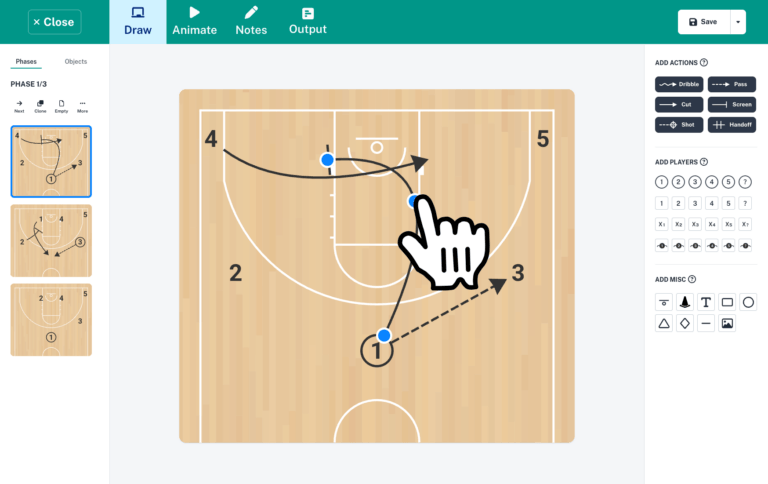
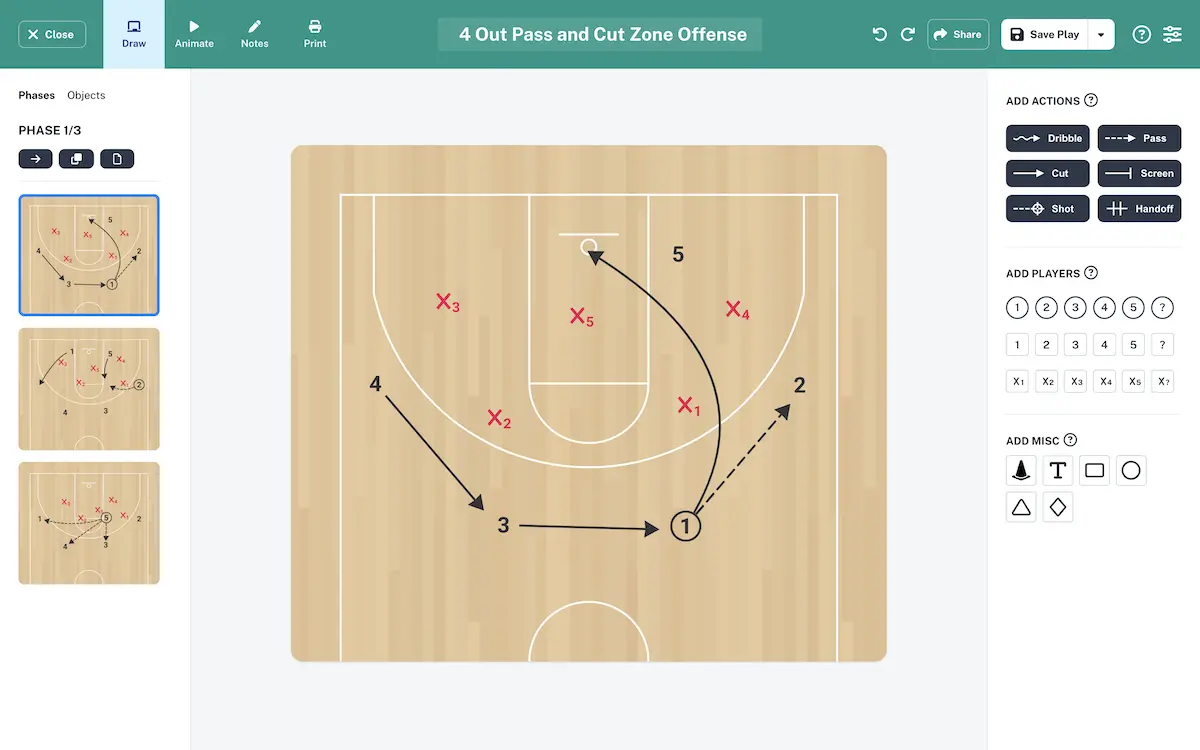
Create plays with our intuitive drag & drop editor.
Your plays will be animated automatically!
© 2026. The Hoops Geek